


Discover how profit leak detection with Profit Leak Detector can save your e-commerce business from hidden revenue loss. Learn to identify, calculate, and prevent profit leaks across Shopify, Amazon, eBay, and Walmart.
Picture this: your e-commerce business appears profitable. Sales are growing, ROAS looks healthy, and revenue is climbing month over month. But when you check your bank account, the numbers don’t add up. Money is disappearing—not through theft or fraud, but through hidden profit leaks that quietly drain your margins.
Research shows the average company loses between 5% and 9% of its earnings each year to revenue leakage . For a business doing $1 million in annual revenue, that’s $50,000 to $90,000 vanishing into thin air. These aren’t catastrophic one-time losses; they’re tiny drips that slowly erode profitability day after day.
This comprehensive guide will teach you everything you need to know about profit leak detection: what causes profit leaks, how to find them, how to calculate their impact, and most importantly, how to plug them for good.
What Is Profit Leak Detection?
Profit leak detection is the process of identifying, analyzing, and preventing the gradual loss of revenue that occurs when a business fails to collect money it has rightfully earned . Unlike fraud or theft, profit leaks typically stem from operational inefficiencies, billing errors, system gaps, and hidden fees that go unnoticed in daily operations.

In the e-commerce context, profit leaks manifest as:
- Platform fees that eat into margins (Amazon FBA fees, eBay final value fees, Shopify transaction fees)
- Billing inaccuracies where customers are undercharged or discounts are misapplied
- Shipping cost overruns from carrier surcharges and incorrect rates
- Advertising waste from campaigns that generate revenue but negative profit
- Data entry errors that create discrepancies between systems
The goal of profit leak detection isn’t just to spot these issues—it’s to create systems that prevent them from happening in the first place.
What Causes Profit Leaks in E-commerce?
Understanding the root causes of profit leakage is the first step toward prevention. Here are the most common culprits affecting online sellers today:
1. Billing Inefficiencies
Billing errors are among the leading causes of revenue leakage. Inaccurate prices, incorrect product quantities, and missed payments all contribute to lost revenue . For subscription-based businesses, these errors compound over time—a 10% billing error rate can represent significant recurring losses.
2. Platform Fees and Hidden Costs
Each sales platform has its own fee structure, and these costs add up quickly. Amazon charges referral fees, FBA fulfillment fees, storage fees, and advertising costs. eBay takes final value fees and promoted listing charges. Shopify has transaction fees, app subscription costs, and payment processing fees .
The challenge? These fees rarely appear in a single, easy-to-read report. They’re scattered across different dashboards, making it nearly impossible to understand true profitability without specialized tools.
3. Price Inaccuracies
Pricing errors occur when products are sold for less than intended. A common scenario: a promotional discount code remains active after its expiration date, allowing customers to continue receiving unauthorized discounts . Similarly, manual pricing updates across multiple channels can lead to inconsistencies where one platform displays outdated pricing.
4. Shipping and Fulfillment Leaks
Shipping costs are notoriously difficult to track accurately. Carrier invoices may not match quoted rates, refunds for lost packages go unclaimed, and dimensional weight errors result in overcharges . For high-volume shippers, these discrepancies can amount to thousands of dollars monthly.
5. Refund and Return Mismanagement
Returns create multiple opportunities for profit leakage. Customers may receive refunds without returning merchandise, refunds may be processed twice, or restocking fees may be overlooked . Each return also involves shipping costs, restocking labor, and potential product depreciation.
6. Data Entry Errors
Manual data entry introduces human error at every stage. Incorrect inventory counts lead to stockouts or overstock situations. Wrong customer information causes failed deliveries. Mismatched SKU data results in incorrect cost of goods sold (COGS) calculations .
7. Fraudulent Activity
While less common than operational errors, fraud remains a concern. Chargeback fraud occurs when customers dispute legitimate charges while keeping the merchandise. Employee theft, fake invoices, and payment fraud all contribute to revenue leakage .
Try Profit Leak Detector Now with 40% off
How to Detect Profit Leaks in Your Business
Profit leakage is sneaky because it rarely shows up in one clear place. You usually spot it when numbers just don’t add up . Here’s a systematic approach to detection:
Conduct a Comprehensive Financial Audit
Start by reviewing your sales records and comparing them to actual revenue. Does your total revenue match the amount of product sold? Conduct an inventory audit—do your inventory records match sales reports? Review all recent promotions and double-check your online pricing for accuracy .
Monitor Key Performance Indicators (KPIs)
Several KPIs can help identify where revenue is being lost:
- Billing Accuracy Rate: (Number of accurate bills / Total bills generated) x 100
- Payment Success Rate: The percentage of attempted payments that process successfully
- Refund Rate: The percentage of sales that result in refunds
- Shipping Cost Percentage: Shipping costs as a percentage of total revenue
Look for Patterns and Anomalies
Start by looking for patterns in your data. Compare what you expected to charge or collect with what actually posted. Focus on :
- Billing mismatches: Carrier invoices that don’t align with quoted rates
- Refund inconsistencies: Missing credits for lost or delayed shipments
- Data discrepancies: Shipments marked complete that never reached customers
- Repeated exceptions: The same error showing up across multiple carriers or accounts
Perform a Root Cause Analysis
The root cause analysis framework helps identify why revenue leakage occurs. Start by defining your problem (revenue leakage), brainstorm potential causes (inaccurate billing, unauthorized discounts), analyze each causal factor using your KPIs, and determine which ones are to blame .
Drill Down to SKU-Level Profitability
Aggregated financial data hides profit leaks. To truly understand where money is being lost, you must analyze profitability at the SKU level across each sales channel .
Consider this example from profit analyst Tracey Smith: A company with a healthy 65% gross margin at the aggregate level discovered that individual SKUs had margins ranging from negative to excellent. One product showed a -25% gross margin, meaning it actually lost money with every sale—a fact completely invisible at the company level .
Try Profit Leak Detector Now with 40% off
How to Calculate Revenue Leakage
Calculating revenue leakage doesn’t require a forensic audit team. The formula is straightforward :
Expected Revenue – Actual Collected Revenue = Revenue Leakage
Step-by-Step Calculation Process
- Define your expected revenue: For most e-commerce operations, this means the total value of what you should have received based on your sales, shipping charges, and billing system.
- Determine actual collected revenue: Calculate how much you actually collected after refunds, credits, chargebacks, and fees.
- Calculate the difference: Subtract actual from expected to determine your total revenue leakage.
A Practical Example
Let’s say your company’s expected monthly revenue is $200,000. After processing refunds, handling lost-package credits, and accounting for platform fees, you actually bring in $191,500.
That missing $8,500 represents your monthly revenue leakage. Over a year, that’s over $100,000 in annual losses—money that simply vanished without a single “critical issue” alert .
Calculating Leakage Percentage
To understand the relative impact, calculate your leakage percentage:
(Revenue Leakage / Expected Revenue) x 100 = Leakage Percentage
In the example above: ($8,500 / $200,000) x 100 = 4.25% leakage rate
Industry averages vary, but research suggests the typical company loses between 2% and 5% annually, with some e-commerce businesses experiencing rates as high as 9% .
Try Profit Leak Detector Now with 40% off
The Problem with Multi-Platform Selling
Modern e-commerce rarely involves a single sales channel. According to recent research, 93% of sellers operate on three or more platforms, and 72% manage ten or more storefronts . This complexity creates a perfect storm for profit leakage.
The Data Chaos Problem
When you sell across multiple platforms, your data becomes fragmented. Each platform has its own reporting system, fee structure, and currency. Consider what sellers face :
- An average finance team handles 18 different currencies and 21 distinct fee categories monthly
- Each platform requires manual data export and transformation
- Excel formulas break when platform fee rules update
- Currency fluctuations add another layer of complexity
Real-World Pain Points
Sellers describe their struggles vividly:
“We do Amazon, AliExpress, independent sites, Temu, and TikTok across multiple platforms. Each system has different logic, so our finance team has to transform data differently for each platform. It’s incredibly time-consuming.” — 3D Printing Seller
“Our profit analysis is primitive—exporting payments and receipts for each product, then manually calculating profits over time.” — Home Goods Seller
“With over a dozen platforms, calculating product profits means exporting from every platform and every warehouse, then merging into one Excel sheet. Each platform takes half a day to process.” — Multi-Platform Seller
The Human Cost
Beyond the financial leakage, multi-platform selling creates operational drag. Tasks that could take minutes with integrated systems consume hours or days of manual work. The average e-commerce business spends 15+ hours weekly on manual profit tracking —time that could be spent on growth activities.
Why ROAS Is a Misleading Metric
Return on Ad Spend (ROAS) is one of the most widely tracked metrics in e-commerce, but it can also be one of the most deceptive when used in isolation.

Try Profit Leak Detector Now with 40% off
The ROAS Illusion
ROAS measures revenue generated per dollar of ad spend. A 500% ROAS means every $1 spent on ads generates $5 in revenue. On the surface, that looks fantastic.
But ROAS tells you nothing about profit. That $5 in revenue might represent only $2 in profit after product costs, platform fees, and shipping expenses. In some cases, a “successful” campaign by ROAS standards can actually lose money .
The Profit Reality
Consider this example:
| Metric | Campaign A | Campaign B |
|---|---|---|
| Ad Spend | $1,000 | $1,000 |
| Revenue Generated | $5,000 | $3,500 |
| ROAS | 500% | 350% |
| Product Costs | $3,000 | $1,500 |
| Platform Fees | $750 | $350 |
| Shipping Costs | $500 | $200 |
| Net Profit | ($250) | $450 |
Campaign A looks better on paper with 500% ROAS, but it actually loses $250. Campaign B appears weaker at 350% ROAS but delivers $450 in real profit .
True Profit Tracking
This is why profit leak detection must go beyond surface metrics. By tracking true profit after all costs—product costs, platform fees, shipping, advertising—you gain an accurate picture of which campaigns, products, and channels actually contribute to your bottom line .
How to Prevent Profit Leaks
Once you’ve identified profit leaks, the focus shifts to prevention. Here are proven strategies to protect your margins:
1. Automate Manual Processes
Humans are notoriously unreliable at repetitive data entry. Every time someone manually edits an invoice or types in a carrier rate, the odds of error increase .
Automation tools handle billing, label generation, and reconciliation without mistakes. They don’t forget decimals or overlook fees. Let technology handle the repetitive work while your team focuses on strategic initiatives .
2. Unify Your Data Across Platforms
When shipping, finance, and operations each maintain separate records, errors multiply. Centralize your data so everyone works from the same numbers. Once your systems agree with each other, half your problems disappear .
Modern profit intelligence platforms automatically sync data from Shopify, WooCommerce, Amazon, eBay, Walmart, and major ad platforms, creating a single source of truth for profitability .
3. Establish Clear Pricing and Promotion Policies
Pricing errors often stem from poor promotion management. Set clear limitations and expiration dates for all discount campaigns. Use tools that automatically deactivate promotions after their scheduled end dates .
Regularly audit your pricing across all channels to ensure consistency. Price disparities between platforms can erode customer trust and create arbitrage opportunities that hurt margins.
4. Implement Robust Invoicing and Billing Systems
Optimize your invoicing and billing systems to avoid pricing errors and inaccurate billing. Establish verification processes for all invoices to confirm customer data and order information is correct. Set up revenue recognition processes where your accounting team tracks sales and revenue accounts to avoid inaccurate financial statements .
5. Monitor Carrier Performance and Invoices
Carriers are partners, not royalty. Review their invoices and performance regularly. If one consistently adds mystery fees or misses delivery windows, negotiate better terms or switch providers .
Track shipping cost trends over time. Sudden increases may indicate rate changes, dimensional weight errors, or incorrect zone calculations that need investigation.
6. Use AI for Pattern Detection
You can’t manually analyze thousands of transactions without missing things. AI-powered tools excel at spotting billing anomalies, refund spikes, and sudden cost jumps long before they appear in standard reports .
Machine learning algorithms can detect patterns humans would never notice, flagging potential issues for investigation before they become significant losses.
7. Establish Cross-Department Collaboration
Revenue leakage rarely stays confined to one department. Finance tends to see the numbers dip first, while operations often plays a part in how it happened .
When finance and operations work independently, gaps appear. When they collaborate, those gaps close. Finance brings structure and accountability, while operations provides visibility and speed. Together, they can build processes that keep revenue protected .
Profit Leak Detection Tools and Software
Modern profit leak detection requires specialized tools that can handle the complexity of multi-platform e-commerce. Here’s what to look for:
Key Features of Profit Leak Detection Software
Automatic Data Synchronization
The software should automatically pull data from all your sales channels, ad platforms, and payment processors. Manual data entry defeats the purpose and introduces new opportunities for error .
Multi-Platform Support
Look for tools that integrate with all the platforms you use: Shopify, WooCommerce, Amazon, eBay, Walmart, Facebook Ads, Google Ads, TikTok Ads, and more .
Real-Time Profit Calculations
Profit should be calculated in real-time, not weeks after the fact. You need to know today whether a campaign, product, or channel is profitable .
SKU-Level Analysis
Aggregate data hides problems. Your tool must provide product-level profitability insights so you can identify which items are truly driving profit and which are quietly losing money .
Cost Overrun Detection
The best tools proactively alert you when costs spike or margins drop below targets. These alerts let you address issues before they significantly impact profitability .
Cross-Platform Fee Analysis
Different platforms have different fee structures. Your tool should help you compare true profitability across channels so you can optimize where to sell .
Introducing ProfitLeak Detector
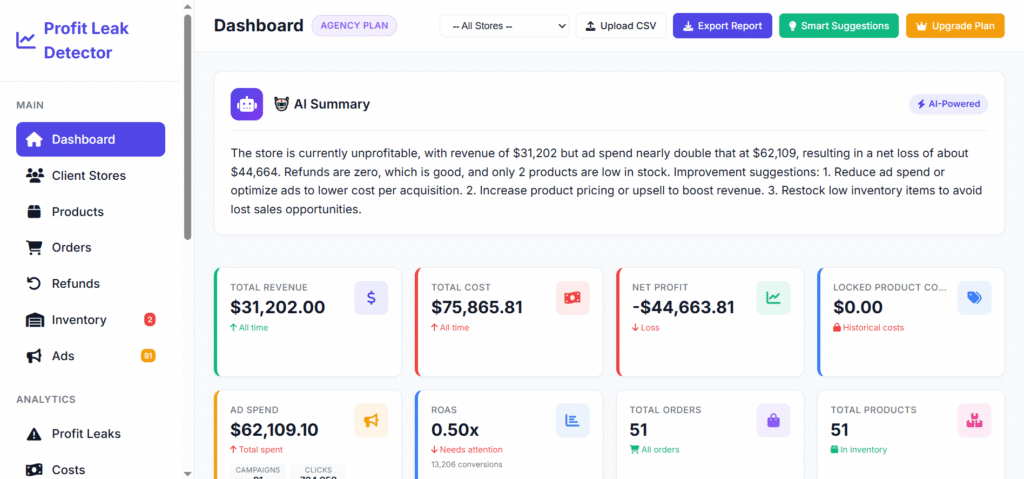
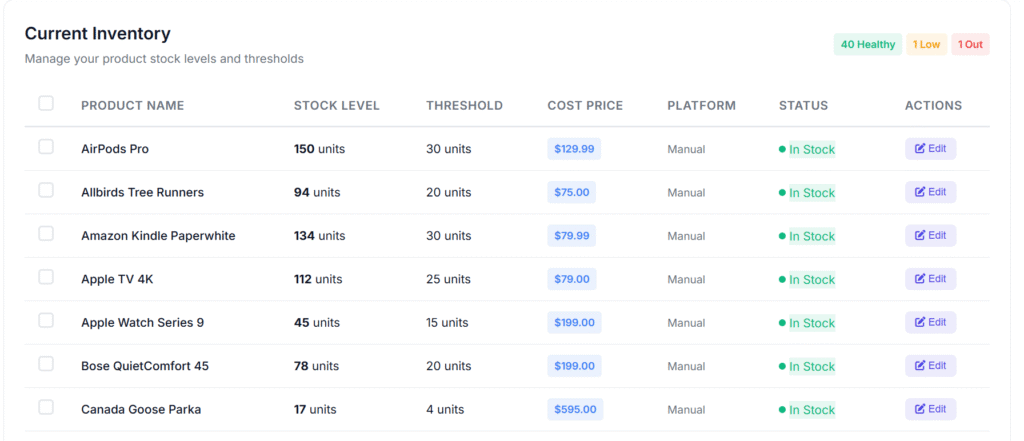
ProfitLeak Detector is a comprehensive profit intelligence platform designed specifically for multi-platform e-commerce sellers. It automatically syncs data from Shopify, WooCommerce, Amazon, eBay, Walmart, and major ad platforms to show your true profit after all costs.
Key benefits include:
- +32% average profit increase for users who systematically plug profit leaks
- -67% reduction in profit leaks through automated detection
- 99.9% data accuracy compared to 50-60% with manual methods
- 15+ hours weekly saved by eliminating manual spreadsheet work
The platform detects cost overruns, identifies pricing vulnerabilities, and provides real-time alerts when profit margins drop below targets .
Frequently Asked Questions About Profit Leaks
What is the difference between revenue leakage and profit leakage?
Revenue leakage refers specifically to money that should have been collected but wasn’t—underbilled customers, missed payments, unapplied fees. Profit leakage is broader, encompassing revenue leakage plus margin erosion from cost overruns, inefficient ad spend, and hidden expenses .
How much revenue do companies typically lose to leakage?
Research indicates the average company loses between 2% and 5% of revenue to leakage annually. For e-commerce businesses with complex fee structures and multiple platforms, that figure can reach 9% or higher .
Can profit leaks be completely eliminated?
While complete elimination is unlikely, most businesses can reduce profit leakage by 50-70% through systematic detection and prevention. The goal isn’t perfection—it’s capturing the majority of lost revenue before it impacts your bottom line .
How often should I check for profit leaks?
Manual checks should be conducted monthly, with quarterly deep dives. However, the best approach is continuous monitoring through automated tools that alert you to issues in real-time .
What’s the first sign of a profit leak?
The most common early warning sign is a discrepancy between expected and actual bank balances. If revenue seems healthy but cash isn’t growing as expected, profit leaks are likely the cause .
Are profit leaks more common on certain platforms?
Each platform has unique fee structures and potential leak points. Amazon has complex FBA fees and storage costs. eBay’s promoted listings can eat margins. Shopify’s app ecosystem creates subscription creep. Multi-platform sellers need visibility across all channels .
Do I need special software for profit leak detection?
While small sellers can manage with spreadsheets, the complexity of multi-platform e-commerce quickly overwhelms manual methods. Automated profit intelligence tools pay for themselves by recovering lost revenue and saving hours of manual work .
Conclusion: Take Control of Your Profitability
Profit leak detection isn’t just about finding lost money—it’s about building a foundation for sustainable growth. When you know exactly how much profit each product, campaign, and channel generates, you can make confident decisions about where to invest and what to cut.
The businesses that thrive in competitive e-commerce markets are those that move beyond revenue metrics to true profit intelligence. They understand that a sale isn’t a success until all costs are accounted for and real profit is secured.
Ready to find your hidden profit? Start with a comprehensive audit of your current operations. Look for discrepancies between expected and actual revenue. Drill down to SKU-level profitability across all channels. And consider implementing automated profit intelligence tools to catch leaks before they drain your margins.
The money you’re losing to profit leaks is still there—it’s just scattered across platform fees, billing errors, and operational inefficiencies. With the right approach to profit leak detection, you can bring that money back where it belongs: your bottom line.