
Stop losing money on customer tabs. Learn how to track restaurant credit sales, set limits, and automate collections — all in one system.
The Silent Profit Leak
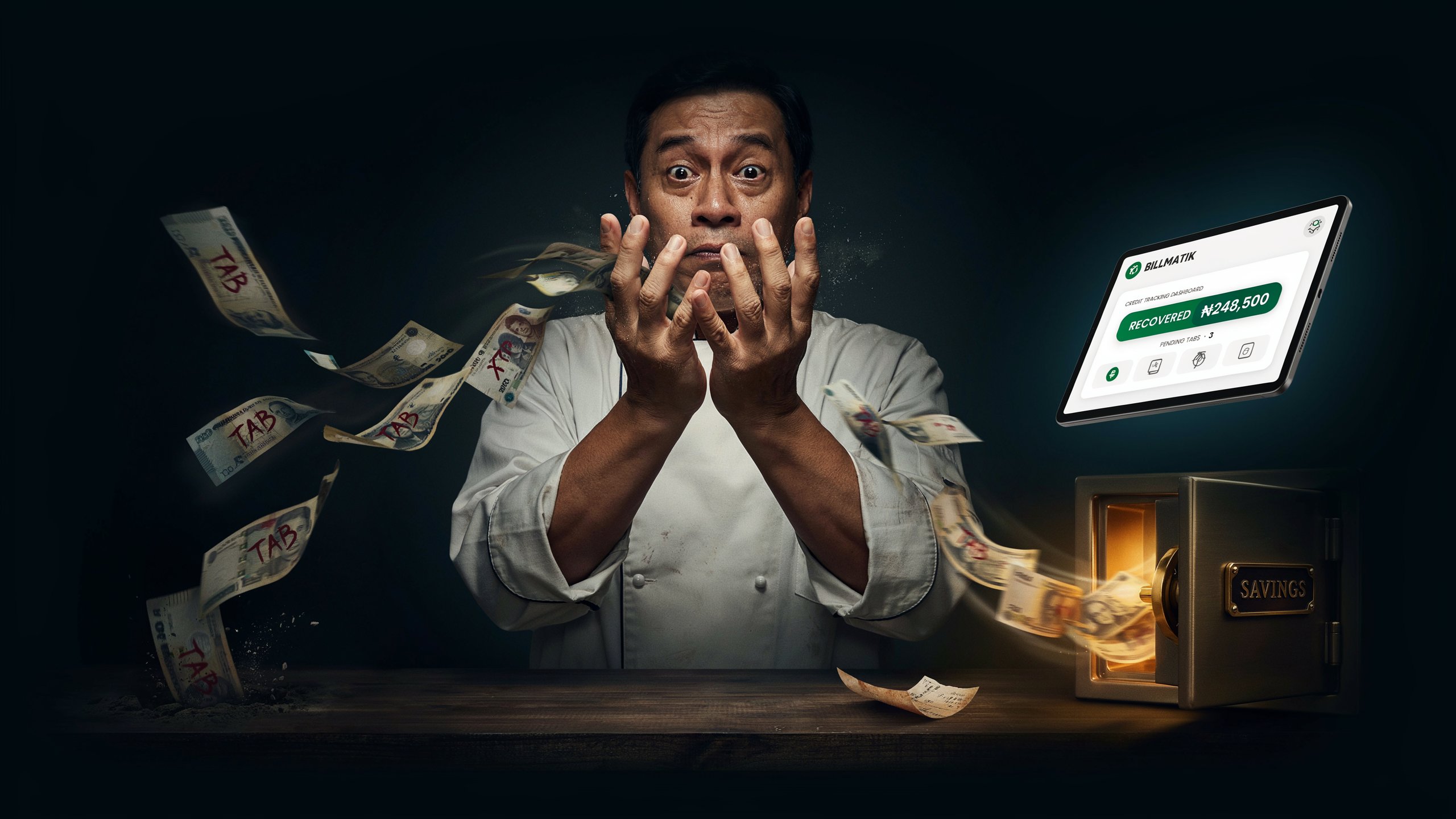
You know the scenario. A regular customer walks in, greets your staff by name, orders their usual meal, and says those five words every restaurant owner dreads: “Just put it on my tab.”
You nod, smile, and write it down in a notebook. Or maybe you have a spreadsheet somewhere. Or perhaps you just remember — because it’s only a few customers, right?
Then weeks go by. The notebook gets lost. The spreadsheet hasn’t been updated. The customer hasn’t come back. And you have no idea who owes you money, how much, or when it’s due.
This is restaurant credit sales in Africa and South Asia — and it’s costing restaurant owners millions.
Customers who maintain tabs are often some of your most profitable patrons. They spend more, visit more often, and are loyal to your business. Yet the informal nature of tabs makes it incredibly difficult to track who’s overdue and how much they owe. Unpaid balances, informal notes, and missing records can quickly become unmanageable — and unprofitable.
Some customers may even disappear without settling their accounts. And when that happens, you’re not just losing a sale — you’re losing money you’ve already spent on ingredients, labor, and overhead.
In this guide, you’ll learn exactly how to track restaurant credit sales, why most restaurants fail at it, and how a modern POS system with built-in credit management can save you thousands.
The Problem: Why Restaurant Credit Tracking Fails
The Manual Method (and Why It’s Broken)
Most restaurants in Africa and South Asia manage customer tabs the old-fashioned way:
- Notebooks and scrap paper — Orders get written down, pages get torn out, notebooks get lost
- Spreadsheets — Better than paper, but rarely updated consistently
- Memory — “I’ll remember” — until you don’t
- Post-it notes — Stuck to the register, the wall, or the till
The results are predictable:
| Problem | Impact |
|---|---|
| Lost records | Can’t collect what you can’t track |
| No due dates | Customers pay whenever they feel like it |
| No credit limits | One customer owes ₦200,000 before you notice |
| No follow-up system | Overdue accounts go uncollected |
| Staff errors | Orders get attributed to the wrong customer |
| No customer history | Can’t see who’s reliable and who isn’t |
One restaurant owner told us: “I had a notebook with 40 customers’ tabs. After six months, I couldn’t read half the writing, and three customers had moved away without paying. I lost over ₦500,000.”
The Real Cost of Poor Credit Management
When you can’t track who owes you money, you’re not just losing individual sales. You’re bleeding cash in ways that compound over time:
- Bad debt write-offs — Money you’ll never recover
- Staff time wasted — Hours spent chasing payments instead of serving customers
- Lost customer relationships — Awkward collection conversations damage relationships
- No growth data — You don’t know which customers are worth extending credit to
Why This Is Especially Painful in Africa and South Asia
In markets like Nigeria, Kenya, India, Pakistan, and the Philippines, credit sales aren’t optional — they’re expected. Regular customers want tabs. Corporate clients want accounts. And if you don’t offer credit, they’ll take their business to someone who does.
But the infrastructure to manage credit properly often doesn’t exist. Many restaurant owners still rely on fragmented or manual processes and lack meaningful access to tools that could help. Informal restaurants face major challenges that limit scalability and profitability — from inefficient supply chains to a lack of data for tracking margins and credit.
The result? Restaurants are caught between a rock and a hard place: offer credit and risk losses, or refuse credit and lose customers.
What Good Restaurant Credit Sales Management Looks Like
The Essential Elements
Experts agree that effective tab management requires several key components:
1. A Clear Policy
Post your tab policy prominently near your register and on menus. Example: “We cap tabs at ₦50,000 and settle weekly.”
2. Customer Qualification Criteria
Not everyone gets credit. Define who qualifies — typically regulars who visit often. Collect basic contact information: full name, phone number, and email address.
3. Credit Limits
Set individual credit limits for each customer. Start small and increase as customers demonstrate reliability.
4. Due Dates
Every tab needs a settlement date. Weekly is common.
5. Consistent Tracking
Use one method consistently. This could be a spreadsheet or — far better — a POS system with built-in credit management.
6. Status Monitoring
Track each customer’s status: current, due, or overdue. Color-coding helps — green for current, yellow for nearing limit, red for overdue.
7. Systematic Collections
Stay on top of payment due dates:
- 1-3 days past due: Text or call to confirm they know their balance
- 7-10 days past due: State the amount owed and ask for settlement within 24 hours
- 14+ days past due: Inform them credit is frozen until balance is cleared
The Data You Need to Track
For each customer with a tab, you need to track:
- Name — Who they are
- Contact information — How to reach them
- Tab start date — When the credit was extended
- Due date — When payment is expected
- Current balance — What they owe right now
- Credit limit — How much they’re allowed to owe
- Status — Current, due, or overdue
Employees should update tabs after each shift, and you should review top balances, tabs nearing their limit, and overdue accounts weekly.
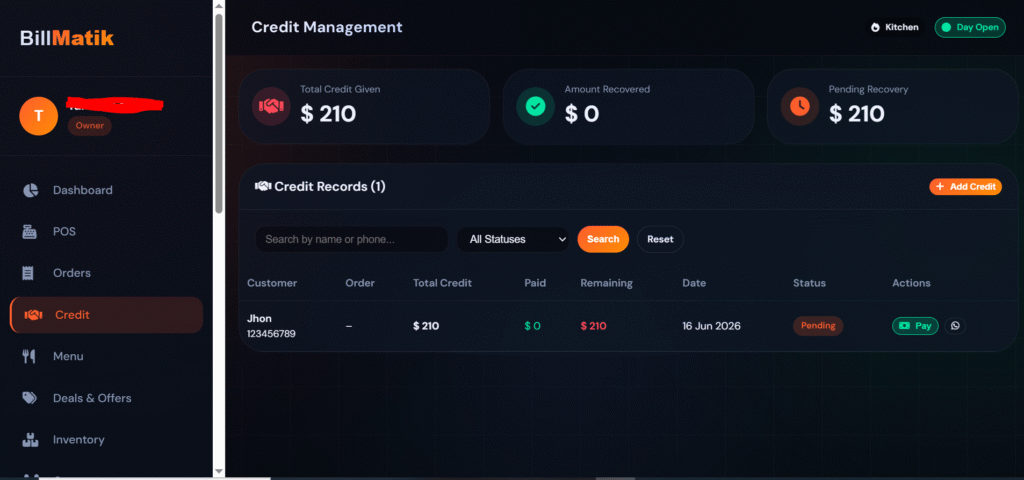
The Solution: Automated Credit Tracking with Billmatik
This is where Billmatik changes everything.
Most POS systems treat credit as an afterthought — if they handle it at all. Billmatik was built with restaurant credit sales as a core feature, designed specifically for the African and South Asian markets where tabs are a normal part of doing business.
What Billmatik’s Credit System Does
Automated Customer Credit Tracking
Every customer who gets a tab is stored in your system with their full profile — name, phone number, email, credit limit, current balance, and payment history. No more notebooks. No more spreadsheets. No more lost records.
Custom Credit Limits Per Customer
Set individual credit limits for each customer. A regular who always pays on time? Higher limit. A new customer? Start small. As customers make on-time payments and give you more business, you can increase their limits.
Due Dates and Automated Reminders
Set due dates for each tab — weekly, bi-weekly, or custom. When a payment is approaching or overdue, Billmatik sends automated WhatsApp reminders to the customer. No awkward phone calls. No staff time wasted chasing payments.
Smart Credit Status
Every customer gets a clear status: current, nearing limit, or overdue. Staff can see at a glance who’s reliable and who needs collection attention.
Customer Credit History
See every order a customer has ever placed on credit. Track payment patterns. Identify your best and most reliable customers. Make data-driven decisions about who gets credit and how much.
Integration with Your Full Restaurant Operations
Credit orders flow through your entire system:
- Orders appear on your kitchen display
- Inventory is auto-deducted
- Customer loyalty points are added
- Sales reports include credit transactions
- Everything is tracked in one unified dashboard
No More Lost Revenue
When you know exactly who owes you money and when it’s due, you collect more. Bad debt drops. Cash flow improves. Your bottom line grows.
How Billmatik Compares to Other Solutions
| Feature | Billmatik | Spreadsheet | Notebook | Other POS Systems |
|---|---|---|---|---|
| Customer profiles | ✅ Automated | ❌ Manual | ❌ Manual | ⚠️ Some |
| Credit limits | ✅ Per customer | ❌ No | ❌ No | ⚠️ Limited |
| Due dates | ✅ Automated | ❌ Manual | ❌ No | ❌ Rare |
| Automated reminders | ❌ No | ❌ No | ❌ No | |
| Credit history | ✅ Full | ❌ Limited | ❌ No | ⚠️ Limited |
| Kitchen integration | ✅ Yes | ❌ No | ❌ No | ❌ No |
| Staff time required | ✅ Minimal | ❌ High | ❌ High | ⚠️ Moderate |
| Loss from bad debt | ✅ Minimized | ❌ High | ❌ Very high | ⚠️ Moderate |
How to Set Up Credit Sales in Your Restaurant
Step 1: Create Your Credit Policy
Decide:
- Who qualifies for credit? (Regulars only? Minimum visit frequency?)
- What’s the default credit limit?
- What’s the payment term? (Weekly? Bi-weekly?)
- What happens if a customer doesn’t pay on time?
Post your policy where customers can see it.
Step 2: Set Up Customer Profiles
With Billmatik, adding a customer takes seconds:
- Enter their name, phone number, and email
- Set their credit limit
- Set their due date
- Save — they’re now in your system
Step 3: Process Credit Orders
When a credit customer orders:
- Select their name at checkout
- Apply the order to their tab
- The order goes to the kitchen
- Stock is deducted
- Their balance updates automatically
Step 4: Monitor and Collect
- Review your credit dashboard daily
- See who’s approaching their limit
- See who’s overdue
- Automated WhatsApp reminders go out
- Collect payments when customers settle
Step 5: Review and Refine
- Review credit performance monthly
- Identify your best credit customers
- Increase limits for reliable customers
- Freeze or reduce limits for risky ones
Real-World Example: How Billmatik Saves a Restaurant Money
Imagine Taste of Lagos — a busy restaurant in Surulere with 200 regular customers, 50 of whom run tabs.
Before Billmatik:
- Tabs tracked in a notebook
- ₦850,000 in outstanding credit
- ₦320,000 written off as bad debt in one year
- Staff spending 10 hours per week chasing payments
- Customers regularly exceeding limits without notice
After Billmatik:
- All 50 customers in the system with profiles and limits
- Automated WhatsApp reminders for due dates
- Bad debt dropped to ₦45,000 (86% reduction)
- Staff time on collections reduced to 2 hours per week (80% reduction)
- Credit limits adjusted based on payment history
- Revenue from credit customers up 22% because reliable customers got higher limits
Annual savings: Over ₦1.2 million.
Frequently Asked Questions About Restaurant Credit Sales
1. Should I offer credit to customers?
Customers who maintain tabs are often profitable, and it may be in your best interest to offer them credit. The key is to do it properly — with clear policies, limits, and tracking.
2. How do I decide who gets credit?
In most cases, a tab makes sense for regulars who visit often. Define “often” in your policy and require basic contact information.
3. What if a customer doesn’t pay?
For accounts more than 14 days past due, contact customers and let them know you won’t extend additional credit until the balance is cleared. With Billmatik, automated reminders help prevent this from happening in the first place.
4. How do I set credit limits?
Start small with new customers. As they make on-time payments, you can increase their limits. Billmatik makes this easy with per-customer limit settings.
5. Can I still offer credit if I use a POS system?
Yes — and you should. A POS system with built-in credit management makes tracking effortless. Billmatik was designed specifically for this.
6. How do I collect overdue accounts without damaging relationships?
Make it easy for customers to pay. Text a link to an online payment system. All communications should be private — via email, text, or discreet face-to-face conversations. Automated WhatsApp reminders from Billmatik are polite, private, and professional.
7. What if a customer disappears without paying?
If you have good reason to think a customer has no intention of paying, file a police report and notify your insurance company. With Billmatik’s tracking, you’ll know who owes what long before it reaches that point.
Conclusion: Stop Losing Money on Credit Sales
Restaurant credit sales don’t have to be a liability. When managed properly, they’re a powerful tool for building customer loyalty and increasing revenue. But without proper tracking, they become a silent profit leak that drains your restaurant’s cash flow.
The solution is simple: track everything.
- Know who owes you money
- Know how much they owe
- Know when it’s due
- Follow up automatically
- Set limits that protect your business
Billmatik makes this effortless. Built-in customer credit tracking, automated WhatsApp reminders, per-customer limits, and full credit history — all in one platform designed for restaurants in Africa and South Asia.
Stop losing money on tabs. Start tracking restaurant credit sales the right way.
Ready to Take Control of Your Restaurant Credit Sales?
Join restaurants across Africa and South Asia that are using Billmatik to track credit, reduce bad debt, and grow their business.
🚀 Get Started with Billmatik Today!
- 🌐 Visit: https://billmatik.mentorsucces.com/
- 📋 Built-in customer credit tracking
- 🤖 Automated WhatsApp reminders
- 💰 Set per-customer credit limits
- ✅ 30-day money-back guarantee
Stop guessing who owes you money. Start knowing.