
Food waste is costing your restaurant thousands. Learn proven restaurant inventory management strategies to reduce waste, track stock in real time, and boost profits.
The Silent Profit Killer in Your Kitchen
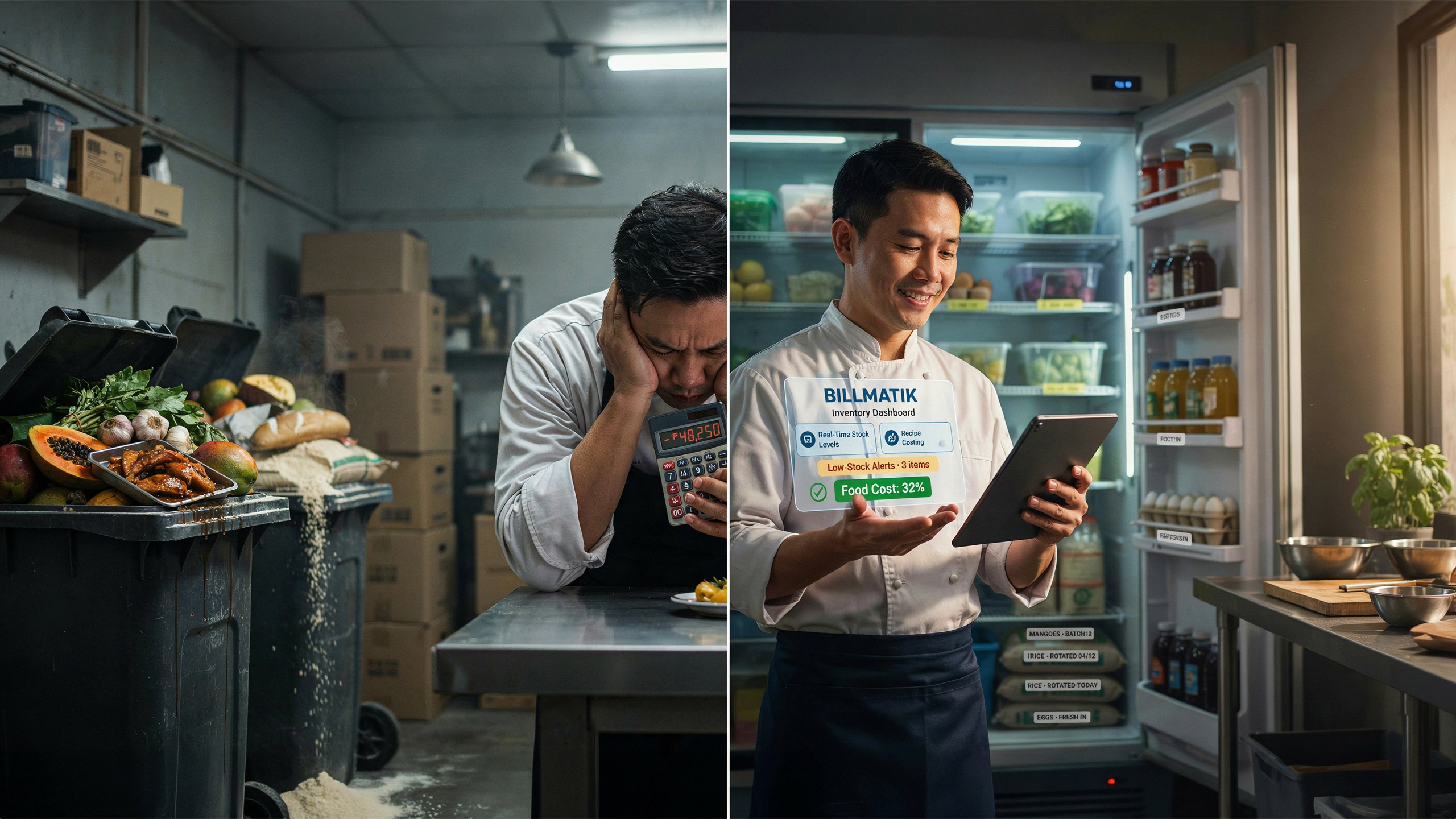
Every day, in restaurants across Africa, Southeast Asia, and around the world, perfectly good food ends up in the trash. Ingredients that were paid for, stored, and prepared — never reaching a customer’s plate.
The numbers are staggering. Restaurants globally lose an estimated $162 billion annually to food waste. Roughly 17% of meals go uneaten, and nearly 70% of that waste comes from what customers leave on their plates. Studies indicate that between 33% and 40% of the food prepared or purchased in restaurants is wasted at various stages — during preparation, storage, or after being served.
For the average restaurant, 4% to 10% of food purchases end up wasted. If you’re spending ₦5 million or ₱500,000 a month on food, that’s ₦200,000–₦500,000 or ₱20,000–₱50,000 literally thrown in the trash every single month.
In Nigeria, the UN reports that 37.9 million tonnes of food is wasted annually at a rate of 189kg per person per year. Restaurants and food services account for 26% of global food waste. In the Philippines, rice waste alone exceeds 255,000 metric tons per year — equivalent to the consumption of 2.79 million people.
This isn’t just an environmental issue. It’s a financial crisis happening in your kitchen right now.
The good news? Every ₦1 or ₱1 invested in reducing food waste generates up to ₦8 or ₱8 in returns. With the right restaurant inventory management system, you can stop the waste, track every ingredient, and protect your profits.
Where Does Food Waste Actually Happen?
To fix the problem, you first need to understand where it occurs. Food waste in restaurants falls into two main categories:
Pre-Consumer Waste (Back-of-House)
This happens before food reaches the customer — often the largest and most preventable category.
Spoilage — Ingredients expire due to overordering, improper storage, or poor stock rotation. Fresh produce, dairy, and meats are especially vulnerable. In one Nigerian study, the highest-rated wasted foods at the preparation stage included cabbage (94.8%), eggs (91.7%), potatoes (91.1%), yam (67.1%), and rice (66.5%).
Over-Preparation — Prepping too much food leads to waste when unused portions cannot be repurposed. Batch sizes based on guesswork rather than data create predictable losses.
Trimmings — Usable food scraps often go to waste instead of being repurposed in broths, sauces, or side dishes.
Expired Inventory — Ingredients that sit too long become unusable.
Post-Consumer Waste (Front-of-House)
This happens after food is served.
Plate Waste — Customers leave food uneaten when portions are too large or meals don’t meet expectations. In fact, nearly 70% of all restaurant food waste comes from what customers leave on their plates.
Order Errors — Mistakes in order fulfillment lead to food being sent back and discarded.
The result? Restaurants are essentially paying for food twice — once to buy it, and once to throw it away.
Read More: How to Track Your Delivery Riders in Real Time (2026 Guide)
The Inventory Management Crisis: Why Most Restaurants Fail
The Manual Method (and Why It’s Broken)
Most restaurants still manage inventory the old-fashioned way:
- Clipboards and spreadsheets — Managers crouch in walk-in coolers, counting boxes by hand
- Gut-feel ordering — “I think we need 30 crates of tomatoes this week”
- No real-time visibility — You don’t know what you have until inventory day
- Disconnected systems — Sales data, inventory, and purchasing are in different places
The results are predictable:
70% of restaurant managers say inventory is their least favorite responsibility. One regional operator told researchers: “My GMs spend more time being detectives than managers”.
The Cost of Doing Nothing
If you’re not actively managing inventory, you’re bleeding money:
- A restaurant spending ₦5 million/month on food wastes ₦200,000–₦500,000/month
- That’s ₦2.4–₦6 million per year — gone
- In the Philippines, that’s ₱20,000–₱50,000/month or ₱240,000–₱600,000/year
And that’s just the direct cost. Add in the labor hours spent on manual counting, the stress on your managers, and the lost customer trust from inconsistent quality or availability.
How Modern Restaurant Inventory Management Solves the Problem
The best restaurant inventory management systems address every stage of the waste problem — from purchasing to plating.
1. Real-Time Stock Tracking
Instead of waiting until inventory day to find problems, modern systems track usage as it happens. Managers know instantly if waste is spiking or if they’re running low on a key ingredient.
What this means for you:
- Know exactly what you have — at any moment
- No more surprise shortages during dinner rush
- Identify waste patterns before they become crises
2. Automated Ordering and Par Levels
Set par levels — ideal stock amounts for each ingredient. The system flags orders above normal usage and suggests what to order based on actual sales data.
What this means for you:
- Order only what you need
- Stop overordering “just in case”
- Reduce spoilage from excess stock
3. FIFO (First-In, First-Out) Stock Rotation
Ensure older stock is always used before newly delivered stock. Train staff to move incoming goods to the back of shelves.
What this means for you:
- Ingredients used before they expire
- Less spoilage
- Better food quality
4. Recipe Costing and Ingredient-Level Tracking
Know exactly what every dish costs to produce, down to the last gram. Auto-deduct stock when orders are placed.
What this means for you:
- Understand your true food costs
- Price menu items profitably
- Identify which dishes are costing you money
5. Waste Tracking and Reporting
Log every instance of waste — what was wasted, how much, and why. Aggregate data to pinpoint trends.
What this means for you:
- Know where your waste is coming from
- Make data-driven decisions
- Track improvement over time
6. Low-Stock Alerts
Get notified before you run out of key ingredients.
What this means for you:
- Never disappoint a customer with “we’re out of that”
- Order proactively, not reactively
- Maintain consistent quality
The ROI: Why Inventory Management Pays for Itself
The return on investment for proper inventory management is extraordinary:
- Every $1 invested in food waste reduction yields about $14 in savings
- For every $1 invested in reducing waste, up to $8 in return can be generated
- 600% return on investment over three years
Real-world examples:
- Costa Vida managers cut inventory time from hours to under 30 minutes per store
- Tropical Smoothie Café turned inventory from its most hated task into a profit-driving process across 1,100+ locations
- A 50-unit regional brand reported significant improvements in food cost understanding and manager retention
How Billmatik Transforms Restaurant Inventory Management
Billmatik is the complete restaurant operating system — and built-in inventory management is a core feature. It’s not an add-on or a separate subscription. It’s part of a unified platform that manages orders, customers, deliveries, and inventory from one dashboard.
What Billmatik’s Inventory Management Does
Auto-Deduct Stock When Orders Are Placed
Every time an order comes in — whether from dine-in, delivery, or WhatsApp — stock is automatically deducted. No manual updates. No guesswork.
Track Ingredient-Level Costs Per Recipe
Know exactly what every dish costs to produce. Price your menu intelligently. Identify which items are profitable and which are costing you money.
Low-Stock Alerts
Get notified before you run out of key ingredients. Never tell a customer “we’re out of that” again.
Real-Time Inventory Visibility
See exactly what you have — at any moment, from anywhere. No more clipboard counting in walk-in coolers.
Integration with Your Full Restaurant Operations
Inventory management works seamlessly with:
- POS — Sales data drives inventory updates
- Kitchen Display System — Orders auto-deduct stock
- Delivery Management — Delivery orders update inventory in real time
- Analytics — See food cost trends and waste patterns
Set Par Levels and Optimize Ordering
Establish ideal stock amounts for each ingredient. Base orders on actual sales data, not gut feel.
Waste Tracking
Log waste events with categories (expired, damaged, over-prepped, etc.). Aggregate data to pinpoint trends and take action.
One Platform, Complete Visibility
No more disconnected systems. No more spreadsheets. Everything in one place — from purchasing to plating.
How Billmatik Compares
| Feature | Billmatik | Manual/Spreadsheet | Basic POS |
|---|---|---|---|
| Auto-deduct stock | ✅ Yes | ❌ No | ⚠️ Some |
| Recipe costing | ✅ Yes | ❌ No | ❌ Rare |
| Low-stock alerts | ✅ Yes | ❌ No | ❌ No |
| Real-time visibility | ✅ Yes | ❌ No | ⚠️ Limited |
| Waste tracking | ✅ Yes | ❌ Manual | ❌ No |
| Integration with operations | ✅ Full | ❌ No | ⚠️ Limited |
| Time required | Minutes | Hours | Hours |
| Manager burnout | ✅ Reduced | ❌ High | ⚠️ Moderate |
Step-by-Step: How to Set Up Inventory Management with Billmatik
Step 1: Upload Your Inventory
Add all your ingredients — names, units, costs, and suppliers. Categorize for easy management.
Step 2: Create Recipes
For every menu item, define the ingredients and quantities. Billmatik calculates the cost per dish automatically.
Step 3: Set Par Levels
Establish ideal stock amounts for each ingredient. Billmatik will flag orders that exceed normal usage.
Step 4: Connect Your POS
Every sale updates inventory automatically. Dine-in, delivery, and WhatsApp orders all deduct stock in real time.
Step 5: Enable Low-Stock Alerts
Get notifications when ingredients are running low. Order proactively.
Step 6: Track Waste
Log waste events with categories and quantities. See trends over time.
Step 7: Monitor and Optimize
Review inventory reports regularly. Identify waste patterns. Adjust ordering and portions accordingly.
Total time to set up: Under 30 minutes.
Frequently Asked Questions About Restaurant Inventory Management
1. How much food do restaurants typically waste?
Studies show restaurants waste 4% to 10% of their food purchases on average. That’s ₦200,000–₦500,000 on a ₦5 million monthly food budget.
2. What causes the most food waste in restaurants?
The biggest culprits are overordering, spoilage, over-preparation, and plate waste (food customers leave uneaten). Nearly 70% of waste comes from what customers leave on their plates.
3. Can inventory management software really reduce waste?
Yes. Studies show every $1 invested in food waste reduction yields $8–$14 in savings. Real-time tracking, automated ordering, and waste analytics dramatically reduce waste.
4. How long does inventory management take with software?
With modern systems like Billmatik, inventory management takes minutes instead of hours. Leading brands have cut inventory time from hours to under 30 minutes per location.
5. Does Billmatik work for multiple locations?
Yes. Billmatik supports multi-location management, with centralized inventory tracking across all your branches.
6. What if I don’t have reliable internet?
Billmatik works offline and syncs automatically when connectivity returns — essential for markets with unreliable internet.
7. How much does Billmatik cost?
Billmatik offers transparent, affordable monthly pricing with no hidden fees. Inventory management is included — not an expensive add-on.
Conclusion: Stop Throwing Money in the Trash
Food waste is the silent profit killer in your restaurant. Every ingredient that spoils, every portion that goes uneaten, every case of tomatoes ordered “just in case” — it’s all money leaving your business.
But it doesn’t have to be this way.
Modern restaurant inventory management gives you:
- Real-time visibility into every ingredient
- Automated stock tracking with every order
- Low-stock alerts before you run out
- Recipe costing to understand your true margins
- Waste tracking to identify and eliminate losses
Billmatik puts all of this in one platform. No more clipboards in walk-in coolers. No more guessing what to order. No more surprised by food cost spikes.
Know what you have. Know what you need. Stop losing money on food waste.
Ready to Take Control of Your Restaurant Inventory?
Join restaurants across Africa, Southeast Asia, and beyond that are using Billmatik to reduce waste, track costs, and boost profits.
🚀 Get Started with Billmatik Today!
- 🌐 Visit: https://billmatik.mentorsucces.com/
- 📦 Real-time inventory tracking
- 📊 Recipe costing and food cost analytics
- 🔔 Low-stock alerts
- ✅ 30-day money-back guarantee
Stop throwing money away. Start tracking your inventory.