

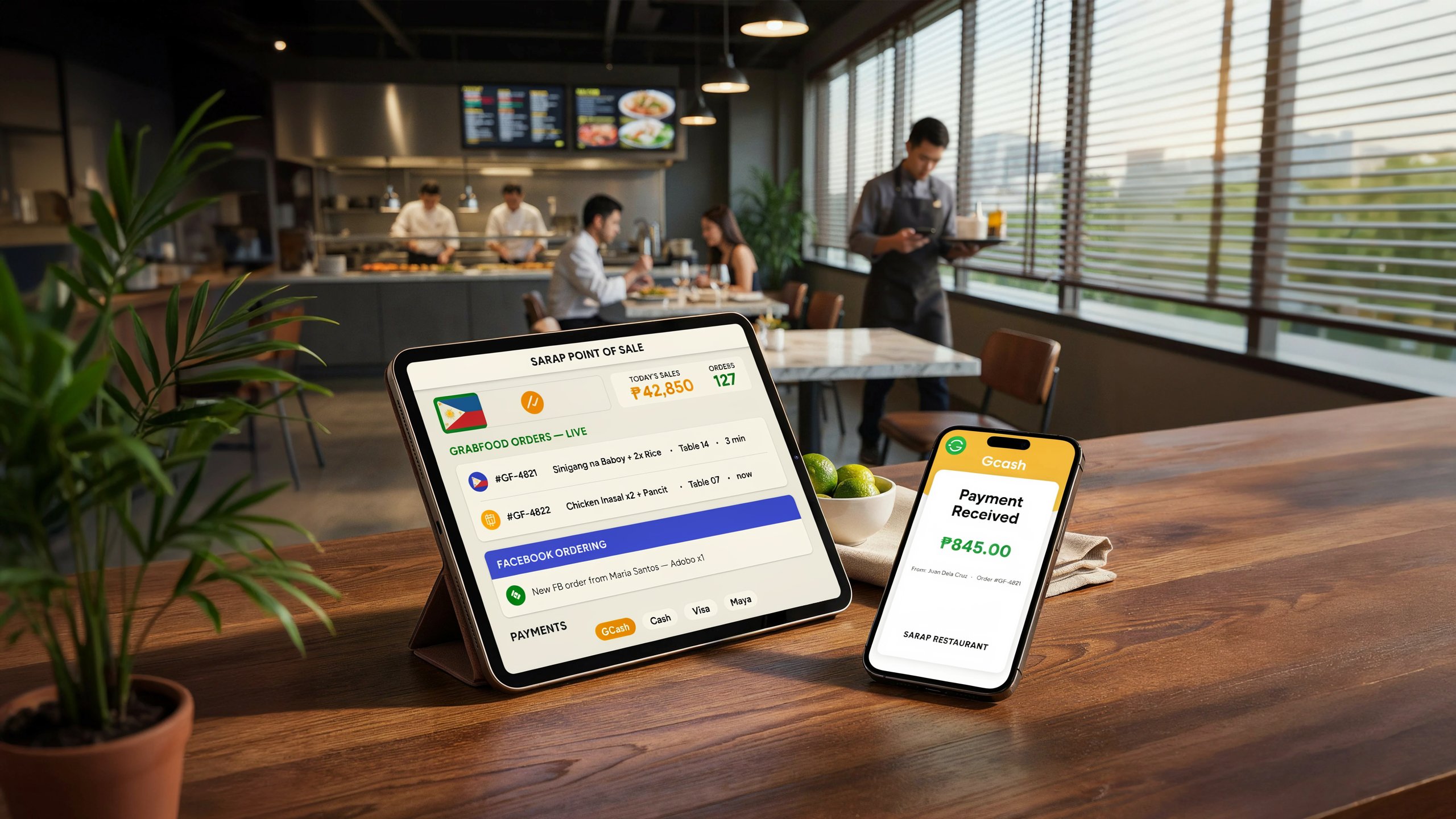
Discover the best restaurant POS system in the Philippines for 2026. GCash integration, GrabFood sync, Facebook ordering, and BIR compliance—all in one platform. Start your free trial today!
The Digital Revolution in Philippine Dining
The Philippine restaurant industry is experiencing unprecedented growth. Generating over ₱1 trillion annually, the food service sector is one of the country’s most dynamic economic drivers. With over 40 million Filipinos ordering food online each month, the demand for seamless, technology-driven dining experiences has never been higher.
But here’s the challenge: most small to medium restaurants in the Philippines still rely on manual systems or basic cash registers. They juggle multiple delivery tablets—GrabFood on one, Foodpanda on another, ShopeeFood on a third—while trying to manage dine-in customers, track inventory, and reconcile payments. The result? Lost orders, frustrated staff, and shrinking profit margins.
This is where a modern restaurant POS system in the Philippines becomes essential. It is no longer just a billing tool but the operational backbone of your business—connecting your tables, kitchen, delivery platforms, and payment systems in one unified dashboard.
In this comprehensive guide, we’ll explore why Philippine restaurants need modern POS systems, the key features to look for, how the best systems integrate with local platforms like GCash and GrabFood, and why Billmatik offers the complete operating system for modern Filipino restaurants.
Why Philippine Restaurants Need a Modern POS System
The Booming Food Delivery Market
The Philippine food delivery market is dominated by GrabFood, which holds a 56 percent market share. Foodpanda and ShopeeFood account for the remainder of the rapidly growing sector. The industry hit $1.2 billion in gross merchandise value (GMV) in 2020** and is projected to reach **$7.46 billion by 2029, with an annual growth rate of 10.39 percent.
Most restaurants now partner with 3-5 delivery platforms, each with its own tablet, interface, and order flow. This fragmentation creates serious operational challenges:
- Order confusion: Staff must watch multiple tablets, increasing mistakes
- Time waste: Switching between apps wastes 15-30 minutes per day per platform
- Lost revenue: Missed orders during peak hours directly impact your bottom line
- Reporting nightmares: Reconciling payouts from GrabFood, Foodpanda, and others takes hours
The Rise of Digital Payments
Contactless payments are growing 40% year-over-year in the Philippines. GCash, the country’s leading mobile wallet with over 80 million users, has become the preferred payment method for millions of Filipinos. Maya, GrabPay, and QR Ph are also gaining significant traction.
A modern restaurant POS system in the Philippines must support these local payment methods natively—not as afterthoughts or third-party add-ons.
Facebook: The Unexpected Ordering Channel
The Philippines consistently ranks among the highest in Facebook usage worldwide. Filipino consumers rely heavily on social media and messaging apps for communication and commerce. Many restaurants already take orders through Facebook Messenger, with customers sending messages like “#Order” followed by their food choices.
The best restaurant POS systems in the Philippines now integrate Facebook ordering directly, capturing orders from your Facebook page and routing them to your kitchen alongside GrabFood, Foodpanda, and dine-in orders.
BIR Compliance
The Philippine government has prioritized the development and implementation of restaurant POS software to improve efficiency and accuracy of restaurant operations. The Bureau of Internal Revenue (BIR) requires accurate sales tracking, official receipt generation, and reporting that meets Philippine tax standards. A BIR-accredited POS system has been formally evaluated and approved by the BIR.
A modern restaurant POS system in the Philippines must handle BIR compliance automatically—eliminating manual data entry and reducing errors by up to 70%.
What Makes the Best Restaurant POS System in the Philippines?
The best restaurant POS system in the Philippines must address the unique needs of the local market while providing world-class features. Here are the essential features to look for:
1. Multi-Platform Delivery Integration
Your POS must connect directly with GrabFood, Foodpanda, and ShopeeFood. Without integration, your staff manually enters orders from each app—increasing errors and delays. With native integration, orders from all platforms appear on one tablet.
Key benefits:
- Orders appear instantly on your kitchen display the moment they’re placed
- Menu updates sync automatically across all platforms
- When an item sells out, it becomes unavailable on GrabFood automatically
- Unified reporting shows dine-in and delivery revenue in one place
2. Local Payment Support
Look for POS systems that support GCash, Maya, GrabPay, and credit card processing. The system should also support QR Ph—the Philippines’ unified QR code standard launched by the Bangko Sentral ng Pilipinas, enabling customers to pay using any participating bank or e-wallet by scanning a single merchant QR code.
3. Facebook and Social Commerce Ordering
With Filipinos spending hours daily on Facebook, your POS should capture orders directly from your Facebook page. When customers order through Facebook, those orders should flow into your main dashboard alongside website and app orders. This eliminates manual entry and ensures you never miss a social media order.
4. Offline Mode
Internet outages are common in the Philippines. Your restaurant POS system should continue accepting orders even when connectivity drops, syncing automatically when the internet returns.
5. BIR Compliance
Ensure the system supports BIR compliance requirements with accurate sales tracking, official receipt generation, and reporting that meets Philippine tax standards. This is not optional—it’s a legal requirement.
6. Kitchen Display System (KDS)
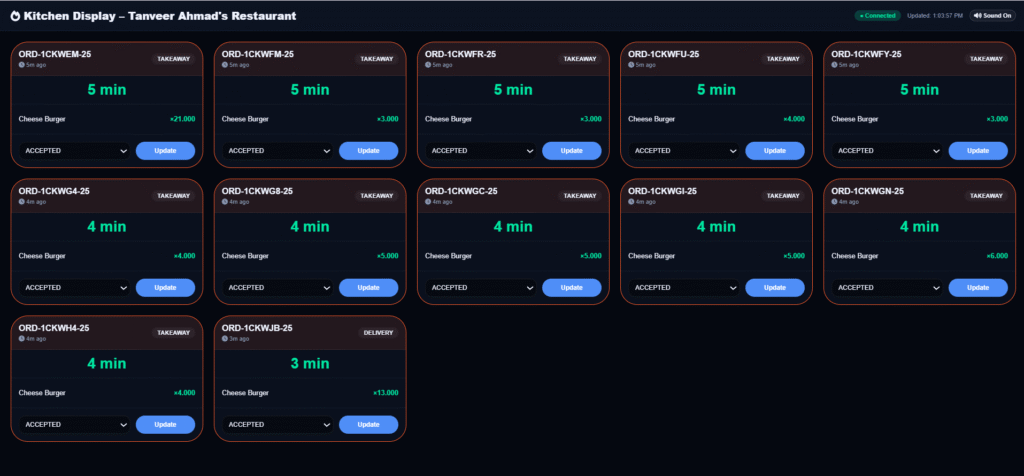
A digital kitchen display eliminates paper order tickets. Orders from all delivery apps appear on one screen, organized by priority and timing. During peak hours when your restaurant handles 50+ orders per hour, this is crucial.
7. Inventory Management
Automatic inventory tracking ensures you never oversell items that are out of stock. When GrabFood shows “Available” but you’re actually sold out, negative reviews follow. Good POS systems auto-update all platforms when inventory runs low.
8. Affordable Pricing
Most Filipino restaurants operate on thin margins. Look for POS systems under ₱2,000/month with no setup fees. Western solutions like Toast can cost ₱5,000+ monthly—far beyond most local budgets.
9. Filipino Language Support
Staff training is faster when your POS interface supports Tagalog. Many international POS systems lack localized language options.
Introducing Billmatik: The Complete Restaurant OS for the Philippines
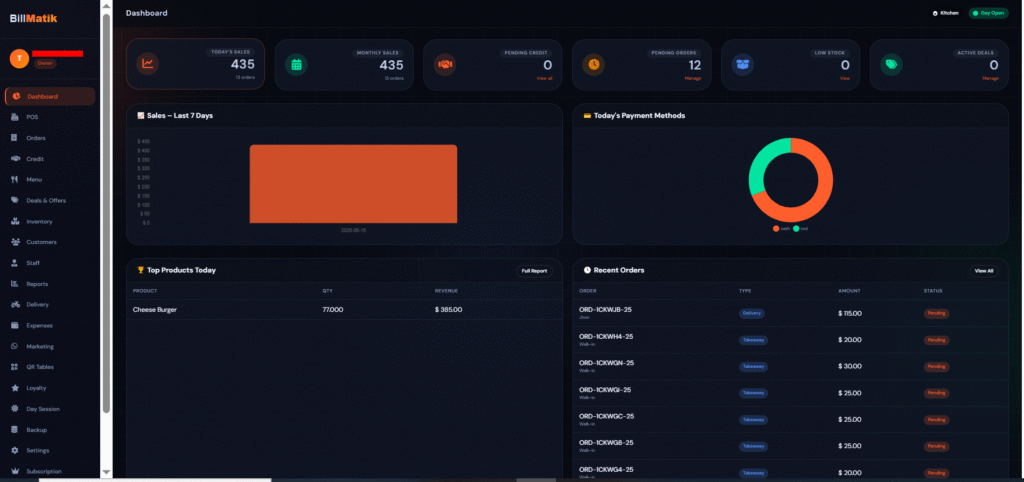
Billmatik is the complete operating system for modern restaurants, purpose-built for the Philippine market. It replaces multiple disconnected tools with a unified platform that manages orders, customers, inventory, delivery, and finance from one dashboard.
Key Features of Billmatik’s Restaurant POS System in the Philippines
Unified Delivery Order Aggregation
Billmatik connects directly to GrabFood, Foodpanda, ShopeeFood, and Uber Eats. Orders from all platforms appear on one tablet—no more switching between apps during rush hour. Your kitchen sees one queue, your customers get faster service, and your staff stays focused.
GrabFood integration works natively—no middleware required. Orders hit your kitchen display the moment they’re placed. Change a price in your Billmatik menu, and GrabFood updates automatically.
Local Payment Processing
Billmatik integrates with Philippine payment processors including GCash, Maya, GrabPay, and major credit card gateways. Accept cash, QR payments, and cards seamlessly—both for dine-in and delivery orders.
Facebook Ordering Integration
Capture orders directly from your Facebook page. When customers order through Facebook, those orders flow into your Billmatik dashboard alongside GrabFood, Foodpanda, and dine-in orders—all in one unified queue.
BIR-Compliant Reporting
Generate audit-ready sales reports automatically. Billmatik supports BIR compliance requirements with accurate sales tracking, official receipt generation, and reporting that meets Philippine tax standards.
QR Code Ordering
Enable contactless dining with QR code ordering—increasingly popular in Philippine restaurants post-pandemic. Customers scan, browse the menu, order, and pay—no app, no waiter wait. Orders go directly to the kitchen, reducing errors and speeding up service.
Kitchen Display System (KDS)
Digital ticket display for kitchen staff. Orders from all channels appear in one queue, organized by priority and timing. No more lost paper tickets or confused kitchen staff.
Menu Management Made Simple
Update your menu once on Billmatik, and changes sync automatically to all your delivery platforms. Out of stock? Remove items instantly across GrabFood, Foodpanda, and Uber Eats without logging into each dashboard separately.
Real-Time Analytics
Track sales, popular items, peak hours, and staff performance with real-time reports designed for data-driven decisions. See which dishes sell best and monitor inventory in real-time.
Multi-Location Management
Manage multiple branches from one dashboard. Perfect for growing Filipino food chains and franchise operations.
Offline Mode
Continue accepting orders even when the internet drops, syncing automatically when connectivity returns.
Affordable Pricing for Local Businesses
Starting at just ₱1,299-1,500 per month per location—that’s up to 70% cheaper than Western alternatives like Toast or Square. No setup fees, no hidden costs.
Local Support
Get help in Filipino or English from a support team that understands the Philippine market.
How Billmatik Compares to Other Restaurant POS Systems in the Philippines
| Feature | Billmatik | StoreHub | Qashier | Traditional POS |
|---|---|---|---|---|
| GrabFood Integration | ✅ Native | ✅ Via Partner | ✅ Via Partner | ❌ No |
| Foodpanda Integration | ✅ Native | ✅ Via Partner | ✅ Via Partner | ❌ No |
| Order Aggregation | ✅ All Platforms | Limited | Limited | ❌ No |
| GCash/Maya Support | ✅ Native | Limited | Limited | ❌ No |
| Facebook Ordering | ✅ Yes | ❌ No | ❌ No | ❌ No |
| BIR Compliance | ✅ Yes | ✅ Yes | ✅ Yes | ❌ No |
| Offline Mode | ✅ Yes | ❌ No | ❌ No | ❌ No |
| Kitchen Display System | ✅ Included | Add-on | Add-on | ❌ No |
| Multi-Location Management | ✅ Yes | ✅ Yes | Limited | ❌ No |
| Monthly Cost | ₱1,299-1,500 | ₱1,499+ | ₱1,299+ | ₱3,000+ |
Sources: Klikit vs StoreHub comparison, Tablet POS comparison, Klikit features
Common Challenges Solved by a Modern Restaurant POS System in the Philippines
Challenge 1: Managing Multiple Delivery Tablets
Solution: Billmatik aggregates GrabFood, Foodpanda, ShopeeFood, and Uber Eats orders on one tablet. No more switching between apps.
Challenge 2: Manual Order Entry Errors
Solution: Orders appear automatically on your kitchen display. No manual re-keying, no wrong items, no missed orders.
Challenge 3: High Delivery Platform Commissions
Solution: Build your own customer database through Facebook ordering, QR ordering, and direct online ordering. Reduce dependence on delivery platforms and their 22-33% commission fees.
Challenge 4: Internet Outages Disrupting Operations
Solution: Offline mode keeps your POS running even when the internet drops.
Challenge 5: Inventory Discrepancies
Solution: Auto-deduct stock when orders are placed. Low-stock alerts prevent overselling. Menu updates sync automatically across all platforms.
Challenge 6: BIR Compliance Headaches
Solution: Generate audit-ready sales reports automatically.
Challenge 7: Missed Facebook Orders
Solution: Capture orders directly from your Facebook page, flowing into your main dashboard alongside all other channels.
Frequently Asked Questions About Restaurant POS Systems in the Philippines
1. What is the best restaurant POS system in the Philippines?
The best restaurant POS system depends on your specific needs. Billmatik offers a comprehensive solution with native GrabFood integration, GCash/Maya support, Facebook ordering, BIR compliance, and affordable pricing starting at ₱1,299/month.
2. How much does a restaurant POS system cost in the Philippines?
Costs vary widely. Entry-level tablet POS systems start at ₱5,000-15,000 for hardware. Monthly software fees range from ₱999 to ₱3,500+. Billmatik offers transparent pricing starting at ₱1,299/month with no setup fees.
3. Does a restaurant POS system need to be BIR-compliant?
Yes. The Bureau of Internal Revenue requires accurate sales tracking, official receipt generation, and reporting that meets Philippine tax standards. A BIR-accredited POS system has been formally evaluated and approved by the BIR.
4. Can a restaurant POS system integrate with GrabFood?
Yes. The best systems offer native GrabFood integration. Billmatik connects directly to GrabFood through API—orders appear instantly on your POS, and menu updates sync automatically.
5. Does a restaurant POS system support GCash and Maya?
Yes. The best POS systems support GCash, Maya, GrabPay, and major credit card gateways natively. Look for systems that also support QR Ph—the Philippines’ unified QR code standard.
6. Can customers order through Facebook?
Yes. Many POS systems now support Facebook ordering. When customers order through your Facebook page, those orders flow into your POS dashboard alongside other channels.
7. How long does it take to set up a restaurant POS system?
Billmatik can be set up in under 30 minutes. Connect your GrabFood merchant account, sync your menu, configure order routing, and go live.
8. What if the internet goes down?
Modern POS systems like Billmatik offer offline mode—continue accepting orders even when connectivity drops, syncing automatically when the internet returns.
Conclusion: Transform Your Restaurant with the Right POS System
The Philippine restaurant industry is growing rapidly, and competition is fierce. To succeed, you need more than just great food—you need great systems. A modern restaurant POS system in the Philippines is no longer a luxury but a necessity.
Billmatik offers the complete operating system for modern Filipino restaurants. From unified delivery order aggregation and local payment processing to Facebook ordering and BIR-compliant reporting, Billmatik provides everything your restaurant needs in one platform.
Why Choose Billmatik?
- ✅ Native GrabFood, Foodpanda, and ShopeeFood integration
- ✅ GCash, Maya, GrabPay, and QR Ph support
- ✅ Facebook ordering integration
- ✅ BIR-compliant reporting
- ✅ Offline mode for internet outages
- ✅ Kitchen Display System included
- ✅ Real-time inventory management
- ✅ Multi-location management
- ✅ Starting at just ₱1,299/month—70% cheaper than Western alternatives
- ✅ Local support in Filipino and English
- ✅ No setup fees, no hidden costs
Ready to Transform Your Restaurant?
Don’t let outdated systems hold your restaurant back. Join the digital revolution and experience the power of a modern restaurant POS system in the Philippines.
🚀 Get Started with Billmatik Today!
- 🌐 Visit: https://billmatik.mentorsucces.com/
- 📞 Contact us for a free demo
- 💰 Take advantage of our risk-free trial
Your restaurant deserves the best. Billmatik delivers it.